A website for your Instagram shop in 2026: Tilda, Shopify, a marketplace, or Magaz
 Aizada · Founder of Magaz 13 min read
 Published: · Updated:

Instagram brings the buyers, but it was never built to be browsed like a shop: no way to check sizes, see what’s in stock, or take in your full range. Four ways to give buyers the catalog Instagram can’t, for sellers in the CIS (страны СНГ): Tilda, Shopify, a marketplace (Kaspi, Wildberries), and Magaz.
Magaz is a done-for-you online catalog for Instagram sellers: the Magaz team builds the store for you, AI turns your phone photos into product listings in every language you sell in, and you keep selling through Instagram and WhatsApp with 0% sales commission.
TL;DR
- Instagram sends the traffic (in Magaz stores about 70% of shoppers arrive from Instagram), but the feed can’t replace a catalog.
- You want a custom website and you’ll build it yourself → Tilda.
- You sell outside the CIS, with 500+ products, and need apps and global card payments → Shopify.
- You want a marketplace’s traffic and installment credit (Kaspi in KZ, Wildberries across the CIS), and accept a per-sale commission (usually 5–20%) → a marketplace.
- You’re a local Instagram brand and want the catalog built for you, commission-free → Magaz.
We make Magaz. Competitor facts below come from each company’s own pricing pages, linked at the end. Where a competitor is the better choice, we say so.
Key facts
- Instagram is a feed, not a browsable shop: buyers can’t filter by size, check stock, or see a full range in one place. New arrivals go to stories that expire in 24 hours.
- Stores we build and run carry 30–1,450 products; kids stores run 250–1,450 (July 2026). Only the highlights a seller has time to post reach Instagram; the rest of the catalog stays unseen.
- About 70% of Magaz catalog visitors arrive from Instagram; they view ~8 pages over ~4 minutes, ~97% on mobile (May 2026, stores with web analytics enabled).
- One store with ~17k Instagram followers gets 1,200+ catalog visitors a month.
- In the CIS stores we run, the typical order goes catalog → chat → payment QR code → shipping. Buyers trust chat, and card-at-checkout is rare.
- Commissions: marketplaces charge per sale (Kaspi ~12% on apparel); Shopify 2.9% + 30¢ (+2% third-party gateway); Magaz flat $30–90/mo at 0%.
- Magaz setup: ~1 day; store live with products: ~3 days.
Why can’t buyers see everything you sell on Instagram?
“Is this still available?” “Do you have it in M?” “Can you send all the colors?”
If you sell on Instagram, you answer this thread all day. Not because your buyers are difficult, but because Instagram gives them no way to look for themselves. It was built as a feed, not a shop: there’s no way to filter by size, check what’s in stock, or see your whole range in one place. You post your best photos to the grid and drop new arrivals into stories that vanish in 24 hours: one to five a day, gone by tomorrow. So a buyer has no way to learn what you carry, what’s in stock, or what exists in their size, except to ask you, one message at a time.
Meanwhile the actual assortment looks like this, across the stores we build and run:
| Store type | Products in the catalog |
|---|---|
| Local apparel brands | 30–200 |
| Menswear | 350–500 |
| Jewellery | 150–250 |
| Kids stores | 250–1,450 |
A kids store on Magaz carries up to 1,450 items. On Instagram, buyers see only the ones the owner had time to post, never the full range. The rest is sold by hand, in Direct, or not sold at all. Every “is this in stock?” is the cost of a shop nobody can browse.
And who’s answering all of this? Most shops like this are run by one to five people, from a phone. No one has a laptop, a web guy, or a free afternoon for “site maintenance.” That’s why the usual advice, “just make a website,” mostly leads to abandoned ones.
What happens when buyers can finally see everything?
Averages across Magaz stores, May 2026:
| Metric | Across Magaz stores |
|---|---|
| Shoppers arriving from Instagram | ~70% |
| Pages viewed per visit | ~8 |
| Time on site | ~4 min |
| On mobile | ~97% |
Averages across Magaz stores with web analytics enabled, May 2026.
Here’s what those numbers mean: a buyer who’d never scroll through hundreds of posts will happily browse a catalog for four minutes. Instagram brings them. The catalog keeps them. Nothing about how you sell changes: same followers, same link in bio. They just finally see everything you sell, not just what made it to the grid.
Tilda vs Shopify vs Kaspi/Wildberries vs Magaz: which fits which seller?
| Magaz | Tilda | Shopify | Marketplace (Kaspi, WB) | |
|---|---|---|---|---|
| What it is | Done-for-you catalog for Instagram sellers | DIY website builder | DIY ecommerce platform | Marketplace: Kaspi (KZ), Wildberries (CIS) |
| Who builds it | The Magaz team, with AI | You | You | You list your products |
| Time to launch | ~1–3 days | Days to weeks | Weeks to months | Days to weeks, often with hired help |
| Monthly price | $30–90 | from ~$9 (750₽) | $29–39 | None |
| Per-sale commission | 0% | 0% (your acquiring fees apply) | 2.9% + 30¢ per sale | Per sale, Kaspi ~12% on apparel; varies by marketplace |
| Payments | Cards via Finik (Kyrgyzstan); order via WhatsApp elsewhere | Your own payment gateway | Shopify Payments not available in the CIS | Marketplace pay + installments (e.g. Kaspi Pay) |
| Language & support | 12 languages; we set it up and support you | Russian | English-first | Russian / local |
| Who keeps the customer | You: name, phone, address | You | You | The marketplace: you never get the buyer’s details |
Tilda
Tilda gives you full control: your own design, your own pages, a blog, the lowest sticker price on this list. If you have web experience (or a designer) and you want to build, it’s a legitimate choice.
The store tools are there: a catalog, size and color variants, filters, search, a cart. But you set them all up and maintain them yourself. One client who left us for Tilda had exactly the right profile for it: years in a global logistics company, fluent English, comfortable with business software. Her self-built site still ended up looking different on every page. That’s not a knock on her; it’s what building alone costs even when you’re good at it.
Pick Tilda if building your own site is something you’d enjoy. If it sounds like a second job, it is one.
Shopify
Shopify is what you graduate to: hundreds of products, several countries, an app for everything. At that scale nothing on this list touches it.
Below that scale, in the CIS, the costs stack up fast. You build it yourself, in an English-first admin. And if you run your business from a phone and have never used desktop software, that isn’t “a learning curve,” it’s a wall. Shopify’s own payment product doesn’t operate in the region, so you’re on a third-party gateway: 2.9% + 30¢ per sale becomes that plus another 2% on the Basic plan. One of our sellers spent six months trying to get a Shopify store live. Her Magaz store took days.
Pick Shopify when you’re expanding past your home market, not to put your first 300 products online.
Marketplaces (Kaspi, Wildberries)
A marketplace brings what nobody else on this list can: a huge built-in audience and the installment credit buyers already use for everything, from Kaspi in Kazakhstan to Wildberries across the CIS. Sales can come without you bringing a single follower.
The price is permanent: a commission on every sale (Kaspi takes roughly 12% on apparel, 5–20% by category; other marketplaces set their own rates), plus fulfillment and logistics fees, for as long as you sell there. And on a marketplace you’re one listing among identical ones, competing on price, and the buyer belongs to the marketplace, not to you. Getting listed at all (product cards, photos, documents, logistics) is work many sellers hand to a hired marketplace manager.
Pick a marketplace for reach into the mass market. Keep your own catalog for your brand and your margins; many sellers run both.
Magaz
Magaz is the narrow option, and that’s deliberate: a professional catalog for a local Instagram brand, built by us instead of by you, feeding orders into the Instagram/WhatsApp selling you already do, at 0% commission.
Pick Magaz if you want the catalog to exist without becoming the person who builds and maintains it.
What does each option really cost?
Sticker prices mislead in both directions.
Shopify Basic at ~$29 costs about the same as Magaz at $30. The difference is everything around the number: 2.9% + 30¢ on every sale, +2% for the third-party gateway, paid apps, and weeks of your time as the builder. Same price; one of them ships built.
A marketplace at $0/month costs the most of all once you’re selling. On Kaspi, 1,000,000 ₸ a month of apparel at ~12% commission is roughly 120,000 ₸ (~$250) every month, against a flat $50 on Magaz. The counterweight is real: a marketplace hands you traffic and installments your own catalog never will. For mass-market goods it can be worth it.
Magaz plans:
- $30/mo: we do the full setup; you upload products. Every feature included.
- $50/mo: we upload your products for you, every month.
- $90/mo: we also photograph your assortment (where our team operates).
- Editorial theme (premium design): $150–250 one-time setup + $80/mo (we upload) or $50/mo (you upload).
ERP sync included on every plan. No sales commission on any plan.
How does “done for you” actually work?
Day 0. You send us your shop’s Instagram and phone number. That’s your part.
Day 1. The store exists: categories built, sizes pre-filled for each category, your logo up, every language and currency you sell in configured.
Day ~3. Products are in and the store is live on your own address. If your products live in MoySklad or Ainur, they sync in automatically, and stock updates in real time from then on.
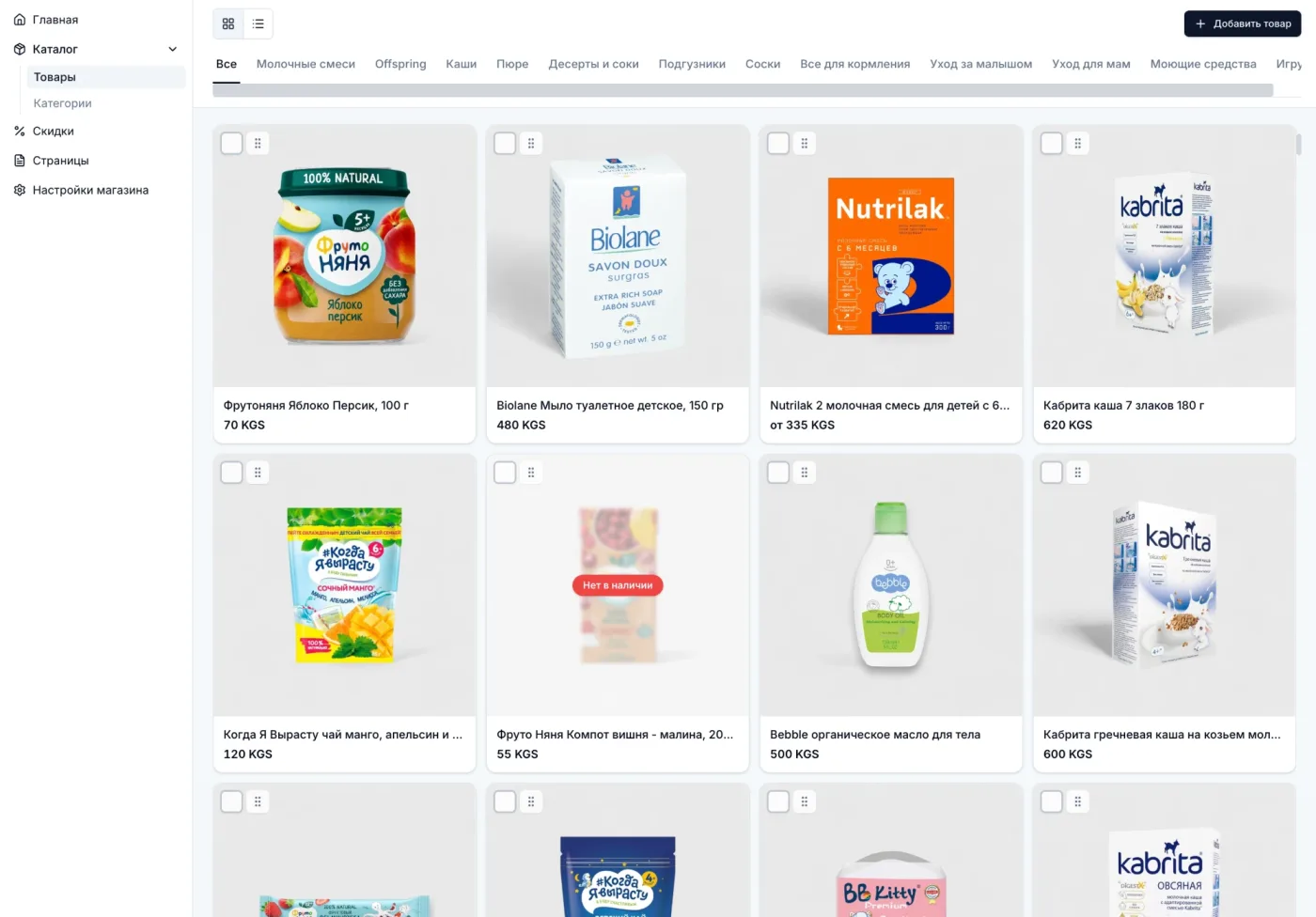
After launch, there’s almost no upkeep:
- Adding a product is one photo. Snap it on your phone, and AI turns it into a clean studio shot, writes the title and description, and translates them into every language your store sells in: no photo studio, no copywriter.
- Or we add your products for you (on the upload plans). Shops often let a site go stale once the person who ran it moves on; on these plans, keeping the catalog current is our job, not yours.
- The catalog handles everything a shop needs: sizes and colors as swatches, per-color photos and video, stock by size, search, filters, curated collections, your own domain, and, if you want the fashion look, a storefront with full-screen video and lookbook reels.
What does a Magaz order look like?
The thread that opened this article (“is it available? in M? in black?”) turns into this. The buyer picks the item in the catalog and sends it to your WhatsApp, color and size already filled in:

And a cart order arrives like this, complete, all at once:

Name, phone, address, exact item, exact size, exact color. Nothing to ask.
“Some customers I just send straight to the site, I don’t want to keep answering ‘is it in stock?’ anymore.” (a Magaz store owner)
Why do orders go to WhatsApp instead of card checkout?
Across the CIS stores we run, we’ve found the same thing: buyers trust marketplaces and they trust chat, but they’re wary of a small brand’s website, and they have a reason. Too many brands put up a site and abandoned it. Fill in the contact form, and nobody ever replies. Message the same brand on WhatsApp, and they answer in minutes.
Magaz is built around that reality, not against it. A WhatsApp order button sits right on the product page: here, purchases happen in chat. The buyer picks an item in the catalog, sends it over, the store replies with a payment QR code, and the item ships. The catalog lets buyers see your full range and what’s in stock; payment and confirmation happen in chat. Card payments are already live in Kyrgyzstan via Finik, and will roll out market by market as an addition, not a replacement.
Who should pick what
- A marketplace (Kaspi, Wildberries): built-in mass-market traffic and installments, in exchange for a per-sale commission (Kaspi ~12% on apparel).
- Tilda: a custom site you design, build, and maintain yourself.
- Shopify: multi-country scale, 500+ products, apps and global payments, and the time to build it.
- Magaz: a professional catalog built for you, plugged into the Instagram and WhatsApp selling you already do, commission-free.
Magaz is not for you if you want a marketplace’s built-in traffic (Kaspi, Wildberries), pixel-level control of your own design (Tilda), or a platform for international scale (Shopify). We’d rather you pick the right tool than the wrong one with our name on it.
Live examples
About Magaz
Magaz builds done-for-you online catalogs for Instagram sellers across the CIS: local brands in apparel, kids’ goods, jewellery, and niche products. The Magaz team sets up each store, AI turns phone photos into listings in every language the store sells in, and sellers keep selling through Instagram and WhatsApp.
By Aizada, founder of Magaz. We build and run online catalogs for Instagram sellers across the CIS. · Updated July 2026
Sources
- Shopify pricing: https://www.shopify.com/pricing
- Tilda pricing: https://tilda.cc/ru/pricing/
- Kaspi Магазин commissions: https://guide.kaspi.kz/partner/ru/shop/conditions/commissions
Competitor prices and fees are taken from the pages above, current as of July 2026. Re-check them before relying on them.
FAQ
What is Magaz?
Magaz is a done-for-you online catalog for Instagram sellers: the Magaz team builds the store for you, AI turns your phone photos into product listings in every language you sell in, and you keep selling through Instagram and WhatsApp with 0% sales commission.
Do I need a separate site if I already sell on Instagram?
Instagram brings buyers in, but the feed can't show your full range, stock, or sizes. A catalog alongside the feed fixes that: across our stores, about 70% of catalog visitors come straight from Instagram.
Isn't a link-in-bio like Taplink or Linktree enough?
For 10–20 items and a few links, a link-in-bio is fine. It isn't a catalog: no real stock and sizes, no search, no filters, no proper checkout. Once your assortment outgrows a short list, you've outgrown the format.
Is there a Shopify alternative for Instagram sellers in the CIS?
Yes. For a small Instagram seller in the CIS, Shopify means building it yourself, in English, with 2.9% + 30¢ per sale and no Shopify Payments in the region. Magaz is the done-for-you alternative: the catalog is built for you, in Russian and 11 other languages, with no sales commission.
Do I have to stop selling on Instagram?
No. Magaz works with Instagram, not instead of it. About 70% of the shoppers who reach a Magaz catalog come from Instagram. The catalog just lets them see and order everything the feed can't show.
Is Magaz more expensive than Shopify?
The entry plan is $30/mo, about the same as Shopify Basic at $29. Shopify then adds 2.9% + 30¢ per sale, and you build the store yourself. Magaz does the setup and takes no commission.
Can I take card payments?
In Kyrgyzstan, yes, cards run through Finik acquiring. In other markets, orders come through WhatsApp or the checkout form, and card payments roll out market by market as sellers arrive.
Will my customers even buy from a website?
They buy from the chat the website feeds. In the CIS, buyers trust chat more than an unattended brand site, so Magaz sends every order to WhatsApp (often settled with a payment QR code), where the relationship already lives. The catalog shows; chat closes.
How long does launch take, can I use my own domain, and what if I already use an ERP?
Full setup (categories, sizes, logo, languages, currencies) takes about a day; with products uploaded, a store is live in roughly three days. Your own domain works. And if you run MoySklad or Ainur, products and stock sync automatically on every plan.